

Here is a scenario that plays out in enterprise IT and operations teams every week. Someone in finance runs a depreciation report. Someone in IT runs an audit. Someone in procurement requests a replacement. All three are working from different data — data that hasn’t been reconciled in months. The spreadsheets exist. The tickets were filed. And yet the organisation still doesn’t know what it owns, where it is, or whether it’s earning its keep.
This is the problem AI asset lifecycle management is built to solve. The global enterprise asset management market was valued at $7.65 billion in 2024 and is projected to reach $19.68 billion by 2030 — a 17.2% CAGR, according to Grand View Research. That’s the growth curve of a category in structural transformation, not slow evolution.
CIOs, CFOs, and operations leaders who treat asset management as an administrative function are about to be outcompeted by organisations that treat it as a strategic intelligence layer. This guide explains exactly what that shift looks like.
What Is AI Asset Lifecycle Management?
Asset lifecycle management (ALM) is the discipline of tracking every physical and digital asset from procurement through disposal. In traditional environments, it’s largely a documentation exercise. AI asset lifecycle management is categorically different: instead of recording what happens to assets, it predicts, optimises, and automates what should happen to them.
“Traditional asset management treats each lifecycle phase as disconnected: procurement buys, operations runs, maintenance fixes, finance replaces. AI connects all four into a single intelligence loop — informing acquisition with failure data, optimising operations with health scores, and projecting replacement based on remaining useful life.” — Industry analysis, 2026
What makes this moment different from previous AI hype cycles is that the foundational infrastructure now exists to support it. IoT sensors stream real-time condition data. Cloud platforms handle compute at scale. ML models trained on millions of maintenance records predict failures weeks in advance. The technology has caught up with the ambition.
The Problem With Traditional Asset Lifecycle Management
The challenges with traditional ALM aren’t the result of poor governance — they’re structural. Manual processes applied to complex, high-volume environments will always produce the same failure patterns.
The Hidden Cost of Not Knowing What You Own
Shadow assets (operating outside official procurement channels) and ghost assets (recorded but physically retired) are more widespread than most organisations acknowledge. 52% of IT professionals cite inventory monitoring as their biggest operational pain point (Teqtivity research). The consequences range from unused licence renewals to balance sheet liabilities with no physical correlate.
The compliance dimension compounds the cost. NASA incurred $20 million in unnecessary penalties over four years attributable to poor asset management — a concrete figure that puts enterprise-scale risk in perspective.
Maintenance That Always Runs One Step Behind
Calendar-based maintenance schedules are best-guess approximations. The result: some assets are serviced long before they need it, others fail between intervals. That mismatch grows worse as asset estates expand across thousands of endpoints, dozens of software vendors, and cloud resources that spin up and down dynamically.
Compliance: The Audit Nobody Wins
GDPR, HIPAA, SOX, and ISO 55000 all impose documentation requirements on asset tracking, transfer, and disposal. Meeting them manually is resource-intensive and backward-looking. 41% of businesses without continuous compliance monitoring report delays in their sales cycles — a direct revenue impact that rarely appears in the compliance cost calculus.
Traditional vs. AI-Powered Asset Lifecycle Management: A Direct Comparison
The differences below are not incremental improvements — they represent a different operating model.
| Dimension | Traditional ALM | AI-Powered ALM |
| Visibility | Manual audits, periodic updates. Assets routinely untracked between cycles. | Continuous real-time visibility. AI flags discrepancies instantly. |
| Maintenance | Calendar-based or reactive. High unplanned failure risk. | Predictive: triggers on condition data. Failures anticipated weeks ahead. |
| Compliance | Manual documentation. Gaps found during audits, not before. | Automated audit trails in real time. Non-compliance flagged proactively. |
| Cost Forecasting | Annual budgets built on historical averages. Surprise replacements common. | AI projects replacement needs 12–24 months out from utilisation and health data. |
| Utilisation | Over-purchasing common. Idle assets undetected until manual review. | Usage analysed continuously. Underutilised assets flagged for redeployment or retirement. |
| Data Quality | Fragmented across spreadsheets, CMDBs, and shadow IT. Stale data is the norm. | Single source of truth with AI-enriched metadata. Automatic anomaly detection. |
| Decision Speed | Reports quarterly or annually. Decisions made on outdated information. | Real-time dashboards and AI recommendations. Decisions driven by live intelligence. |
| Lifecycle Coordination | Procurement, ops, maintenance, and finance operate in silos. | All phases connected in one intelligence loop. Each informs the next automatically. |
| ESG / Sustainability | Environmental impact rarely tracked systematically. | AI tracks energy consumption, carbon footprint, and disposal compliance per asset. |
The most important shift isn’t any single capability — it’s the move from episodic awareness to continuous intelligence. AI changes the relationship between data and decisions.
How AI Transforms Every Stage of the Asset Lifecycle
ALM is a sequence of interconnected decisions that compound over time. AI improves each stage, but the real leverage comes from connecting them: insights at disposition inform procurement; utilisation data shapes maintenance; compliance evidence is generated as a byproduct of normal operations.
Stage 1: Procurement & Acquisition — Smarter From Day One
AI changes procurement inputs. Failure patterns from existing assets inform specifications. Utilisation data identifies whether idle resources could be redeployed before new purchases are approved. Contract and renewal data from contract management and vendor management surfaces pricing benchmarks and SLA performance before decisions are made. The result: buying the right assets at the right time, with evidence-based confidence about total lifecycle cost.
Stage 2: Deployment & Visibility — Real-Time Truth Across the Estate
Deployment is where asset estates fragment. A device leaves the warehouse, gets reassigned, moves offices — and somewhere the tracking record stops reflecting reality. AI-powered asset tracking prevents this. Continuous discovery agents scan networks automatically. AI metadata extraction enriches asset records at ingestion without manual entry. Location, assignment, and compliance status are maintained in real time rather than reconstructed during audits.
Stage 3: Utilisation & Optimisation — Stop Paying for What You Don’t Use
Underutilisation is among the most expensive and least visible costs in enterprise asset management. AI-powered enterprise asset management analyses usage continuously: a licence unused for 90 days triggers reclamation; a server at 8% CPU flags for consolidation; a device assigned to a departed employee surfaces for retrieval. Gartner estimates organisations overspend by 20–30% on software licences alone. Reclaiming underutilised assets eliminates equivalent new purchases.
Stage 4: Maintenance & Health — From Reactive to Predictive
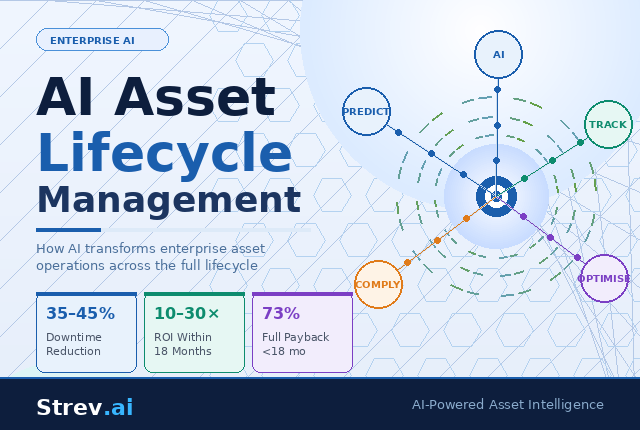
McKinsey Global Institute analysis documents average downtime reductions of 35–45%, maintenance cost savings of 10–25%, and asset lifecycle extensions of up to 20% from AI predictive maintenance. The US Department of Energy reports 70–75% reductions in breakdowns and potential 10x ROI. A 2025 survey of 450 industrial operators found 73% achieved full payback within 18 months at an average first-year ROI of 3.2x.
The mechanism: sensors measure vibration, temperature, and power draw continuously. AI models identify failure signatures days or weeks before any human-observable symptom appears. Workflow automation dispatches maintenance and triggers remediation automatically, eliminating the latency between detection and response.
Stage 5: Compliance & Audit — Automated Evidence, Continuous Readiness
Traditional compliance is retrospective: gather evidence, compile documentation, present to auditors, find gaps, remediate. AI inverts this. Every asset movement, configuration change, and access event is logged automatically. Compliance rules mapped to GDPR, HIPAA, SOX, and ISO 55000 are evaluated continuously against live asset state. The reporting and analytics layer surfaces exceptions that need human attention — before auditors do.
Stage 6: Forecasting & Disposition — Plan Replacements Before They Bite
By modelling remaining useful life from actual condition and utilisation data, AI asset management systems project replacement needs 12–24 months out. Budget cycles align with predicted asset lifecycles rather than arbitrary financial calendars. At end-of-life, data sanitisation verification, environmental compliance documentation, and recycling audit trails are generated automatically — substantially reducing data breach risk from improperly decommissioned assets.
AI Asset Management in the Real World: Industry Use Cases
AI ALM applies differently across industries. Here’s how it plays out across major sectors.
| Industry | Primary AI ALM Use Case | Key Outcome | Representative Platforms |
| Manufacturing | Predictive maintenance on CNC equipment | 35–45% reduction in unplanned downtime | IBM Maximo, GE Vernova APM |
| Healthcare | Medical device lifecycle & compliance | FDA/HIPAA audit readiness; reduced asset loss | ServiceNow HAM |
| IT / Technology | Software licence reconciliation, ITAM | 20–40% reduction in software overspend | Strev, Freshservice, Lansweeper |
| Energy & Utilities | Grid asset health monitoring, ESG reporting | 10–30x ROI on predictive maintenance | Siemens Xcelerator, GE Vernova |
| Retail & Logistics | Fleet and equipment tracking across locations | Reduced ghost assets; faster audits | IoT-integrated EAM platforms |
| Government | Fixed asset compliance, depreciation tracking | Audit-ready records; reduced fines | GovTech + ERP integrations |
Manufacturing: Siemens and the Digital Twin Revolution
At CES 2026, Siemens unveiled the Digital Twin Composer — integrating Siemens’ industrial digital twin with NVIDIA’s Omniverse to create real-time AI-powered representations of physical assets. When a digital twin reflects actual physical state in real time, maintenance decisions shift from schedule-based to condition-based automatically. Siemens’ Industrial Copilot, pairing generative AI with Senseye Predictive Maintenance, is already in production deployment across industrial clients.
IT Asset Management: The Software Licence Problem
For IT organisations, AI asset management’s most immediate value is licence reconciliation. Enterprise software estates routinely include hundreds of vendors and thousands of entitlements. AI-powered IT asset management continuously discovers installed software, matches installations to entitlements, and identifies both overages (compliance risk) and underages (waste). G2’s 2026 report found 7 out of 10 enterprise respondents identified structured metadata as the single most important determinant of AI success — data quality is the foundation on which everything else is built.
Energy & Utilities: Monitoring Assets That Can’t Afford to Fail
GE Vernova’s APM suite monitors over 150 gigawatts of power generation assets globally. At that scale, a 1% improvement in asset availability has nine-figure financial implications. AI enables the continuous monitoring and predictive intelligence that makes those improvements achievable — at a fidelity and continuity no human team could match.
What to Look For in an AI Asset Management System
The feature landscape is crowded with vendors making similar claims. These capabilities should be non-negotiable for enterprise buyers.
1. Continuous Discovery — Not Periodic Scanning
Point-in-time scans produce point-in-time accuracy. An asset estate that changes daily needs discovery that runs continuously.
2. AI-Enriched Metadata, Not Manual Data Entry
AI metadata extraction automatically populates asset attributes at ingestion. Look for platforms where data quality improves over time as the AI learns your environment.
3. Predictive Intelligence, Not Just Dashboards
Dashboards show what is. Predictive intelligence tells you what will be. Look for actionable recommendations — assets approaching failure, licences nearing non-compliance — not just visualisations of current state.
4. Unified Lifecycle Coverage
The value compounds when procurement, operations, maintenance, compliance, and finance share a common data model. Look for systems connecting procurement management, asset operations, contract management, and reporting and analytics in a single platform — not a set of integrations that reintroduce fragmentation.
5. Compliance Automation — Not Just Compliance Features
Ask vendors to demonstrate how audit evidence is generated from normal operations — not how compliance reports are produced. The difference: one eliminates the audit sprint, the other just improves it.
6. Integration Without Custom Development
An AI asset management system that doesn’t integrate natively with your ITSM, ERP, and procurement tools creates a new silo. Evaluate the depth of integrations available out of the box.
Emerging Trends That Will Shape the Next Three Years
Digital Twins and Real-Time Asset Intelligence
Siemens’ Digital Twin Composer (CES 2026) represents the direction of travel: AI that simulates asset behaviour rather than just analysing it. For enterprise asset managers, digital twins make the question ‘what happens if we defer maintenance for 60 days?’ answerable with quantitative confidence rather than engineering judgment — a qualitative shift in how capital decisions are made.
Agentic AI: From Alerts to Autonomous Action
Current AI asset management is largely advisory. The next generation executes multi-step workflows autonomously. Gartner projects 40% of enterprise applications will embed AI agents by 2026. In asset management terms: a system that doesn’t just flag a licence non-compliance — it initiates reclamation, notifies the user, updates the record, and documents the action for audit, all without human intervention. The human role shifts from task execution to exception handling.
ESG and Sustainability Tracking
ESG requirements are creating a new category of asset intelligence demand. Organisations need to report asset energy consumption, carbon footprint, and disposal compliance — data that overlaps almost entirely with what operational asset intelligence already collects. Platforms that unify both eliminate duplicate data infrastructure.
Edge AI and 5G-Enabled Asset Monitoring
The US IoT integration market is growing at 27% CAGR through 2032. Edge computing (AI processing near the asset) combined with 5G connectivity enables real-time asset intelligence in environments where cloud latency was previously a constraint: underground facilities, remote infrastructure, manufacturing floors with real-time safety requirements. For regulated industries, edge AI also addresses data sovereignty concerns by processing sensitive operational data locally.
Frequently Asked Questions
What is AI asset lifecycle management?
AI asset lifecycle management applies artificial intelligence — including machine learning, predictive analytics, and automation — across the full enterprise asset lifecycle, from procurement through disposal. Unlike traditional ALM, it maintains continuous real-time intelligence and generates automated recommendations based on live data rather than periodic manual audits.
How does AI improve asset visibility in an enterprise?
Through continuous discovery agents that detect assets as they connect to networks, AI-enriched metadata that populates asset records without manual entry, and real-time anomaly detection that flags discrepancies between recorded and actual state. The result is a single source of truth that reflects current reality — not the last audit date.
What is predictive maintenance in asset management?
Predictive maintenance uses AI models trained on sensor data — vibration, temperature, power consumption — to forecast equipment failures before they occur. Instead of calendar-based maintenance, it triggers service when condition data indicates an asset is approaching a failure threshold. McKinsey documents average downtime reductions of 35–45% and cost savings of 10–25%.
How does AI asset management software help with compliance?
AI generates audit trails continuously as a byproduct of normal asset operations. Every movement, configuration change, and access event is evaluated automatically against compliance rules (GDPR, HIPAA, SOX, ISO 55000). Non-compliant events are flagged in real time; audit evidence packages are generated on demand without manual compilation.
What is the ROI of AI asset lifecycle management?
73% of industrial operators achieved full payback within 18 months, with an average first-year ROI of 3.2x. The US Department of Energy documents potential 10x ROI from predictive maintenance. McKinsey reports lifecycle extensions of up to 20%. IT organisations typically see 20–40% reduction in licence overspend as the most immediate financial return.
What is the difference between EAM and AI asset management?
Enterprise Asset Management (EAM) is the broader discipline. AI asset management refers specifically to EAM platforms incorporating machine learning, predictive analytics, and automation to move beyond passive record-keeping toward active intelligence. All AI asset management platforms are EAM platforms — not all EAM platforms have meaningful AI capability.
What industries benefit most from AI asset lifecycle management?
Manufacturing and energy/utilities show the highest documented ROI through predictive maintenance on capital-intensive equipment. Healthcare benefits through device compliance under HIPAA and FDA requirements. IT organisations benefit through software licence optimisation and automated ITAM compliance.
What should I look for in an AI asset management system?
Continuous asset discovery, AI-enriched metadata at ingestion, predictive health intelligence (not just dashboards), unified lifecycle coverage from procurement through disposal, native compliance automation, and a deep integration library for ITSM, ERP, and procurement tools. The best platforms eliminate data silos rather than creating new ones.
The Bottom Line
AI asset lifecycle management is not a category upgrade to traditional asset tracking. It’s a different operating model — one that turns asset data from a historical record into forward-looking intelligence that informs procurement, optimises utilisation, predicts failures, automates compliance, and plans replacement before surprises hit the budget.
The market data is unambiguous: 17.2% CAGR in enterprise asset management, documented 10x–30x ROI from predictive maintenance, 40% of enterprise applications embedding AI agents by 2026. The question for CIOs, CTOs, and CFOs is no longer whether AI belongs in your asset management strategy — it’s how quickly you can move from the processes you have to the intelligence you need.
Strev is an AI-powered asset management platform built for the modern enterprise — combining real-time visibility, AI metadata extraction, predictive lifecycle intelligence, contract and vendor management, and compliance automation in a single unified system. See how Strev approaches AI asset lifecycle management — and why top companies have made it their single source of asset truth.