

Most organizations think they have IT asset management under control… until they don’t.
Assets are tracked, lists exist, and systems are in place. Yet renewals are missed, licenses go unused, devices disappear, and compliance gaps surface at the worst possible time.
The problem isn’t visibility. It’s fragmentation.
The types of IT asset management exist because no single system can handle the full complexity of modern assets. Hardware, software, cloud resources, and documentation each follow different rules, lifecycles, and ownership models. Treating them as a single category leads to blind spots.
Understanding these types is not just a technical exercise. It’s the difference between tracking assets and actually managing them.
What Is IT Asset Management?
IT asset management (ITAM) is the discipline of tracking and managing an organization’s technology assets throughout their lifecycle.
This lifecycle typically includes acquisition, assignment, usage, maintenance, renewal, and retirement. However, ITAM is not just about recording these stages. It is about ensuring that assets are used efficiently, remain compliant, and support business operations without unnecessary cost or risk.
In practice, IT asset management sits at the intersection of IT, finance, operations, and compliance. Each of these functions interacts with assets differently, which is why a single approach is rarely sufficient.
Main Types of IT Asset Management
1. Hardware Asset Management
Hardware asset management focuses on physical devices such as laptops, desktops, servers, networking equipment, and peripherals.
At a basic level, it answers fundamental questions: where assets are located, who is using them, and what condition they are in. This is often the first step organizations take when formalizing IT asset management.
However, hardware tracking alone provides limited insight. Knowing that a device exists does not explain whether it is underutilized, nearing end-of-life, or missing required documentation. As organizations grow, hardware management must evolve beyond location tracking into lifecycle awareness.
2. Software Asset Management (SAM)
Software asset management deals with applications, licenses, and usage rights. This has become increasingly important as organizations shift toward subscription-based software models.
SAM helps organizations ensure compliance with licensing agreements while avoiding unnecessary spending. It provides visibility into how software is being used, which licenses are active, and when renewals are due.
Without proper SAM, organizations often face two problems simultaneously: overpaying for unused licenses and risking penalties for non-compliance. This makes SAM both a financial and operational priority.
3. Digital Asset Management
Digital asset management focuses on the files and content associated with assets. This type of IT asset management includes contracts, manuals, certificates, and other supporting documents.
While often overlooked, this type plays a critical role in compliance and operational continuity. An asset without its associated documentation is incomplete. For example, a device without a warranty record or a contract without linked assets creates gaps that can lead to risk.
Digital asset management ensures that information is not only stored but also accessible and connected to the relevant assets.
4. Cloud Asset Management
Cloud asset management tracks resources hosted in cloud environments, such as virtual machines, storage, and services.
Unlike physical assets, cloud resources are dynamic. They can be created, modified, or decommissioned rapidly. This flexibility introduces complexity, especially when managing cost and usage.
Organizations rely on cloud asset management to maintain visibility, prevent overprovisioning, and ensure that resources are aligned with operational needs. Without it, cloud environments can quickly become difficult to control.
READ ALSO: SaaS vs On-Premise: Costs, Differences, and Best Choice
5. Fixed Asset Management
Fixed asset management focuses on the financial aspect of assets. It is primarily used by finance teams to track depreciation, valuation, and reporting.
This type of IT asset management ensures that assets are properly accounted for in financial statements and comply with regulatory requirements. While it overlaps with IT asset management, its focus is not operational usage but financial accuracy. For organizations with significant asset investments, fixed asset management is essential for maintaining financial discipline.
6. Lifecycle Asset Management
Lifecycle asset management connects all other types into a single, continuous process.
Instead of managing assets in isolation, this approach tracks assets from acquisition to retirement while linking them to software, documents, ownership, and workflows. It provides a complete view of how assets are used, maintained, and transitioned over time.
This is where asset management becomes strategic. Decisions are no longer based on static records but on real-time context.
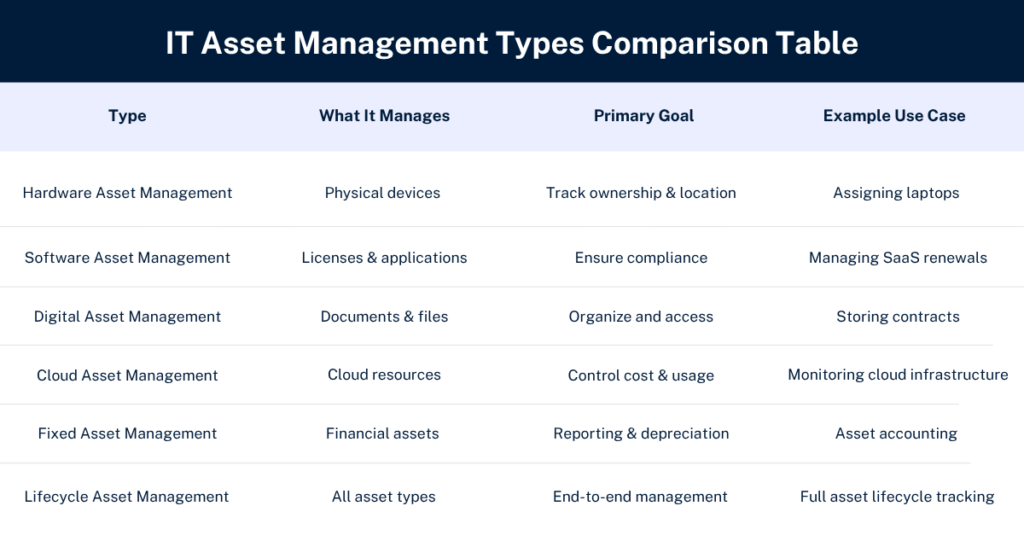
IT Asset Management Types Comparison Table
The table below summarizes how each type differs in purpose and application.
How These Types of IT Asset Management Connect
Rather than operating independently, these types form a layered system:
- Hardware and software represent the core assets
- Cloud extends where assets operate
- Digital assets provide context and documentation
- Fixed assets handle financial tracking
- Lifecycle management connects everything
When these layers are disconnected, organizations rely on manual coordination. When they are unified, asset management becomes structured and reliable.
Why Organizations Use Multiple Types of IT Asset Management
No single type of IT asset management can cover the full lifecycle of modern assets.
Each type exists because assets behave differently. Hardware needs physical tracking. Software requires license and usage control. Cloud resources change dynamically. Financial assets must be reported accurately. Documents provide context that systems alone cannot capture.
In practice, these are not separate problems. They are parts of the same workflow.
Consider a simple example:
WobblyFox Company issues a laptop to an employee. Hardware asset management tracks the device. Software asset management tracks installed licenses. A contract defines warranty or support terms. Finance tracks depreciation. Over time, the asset is reassigned, upgraded, and eventually retired.
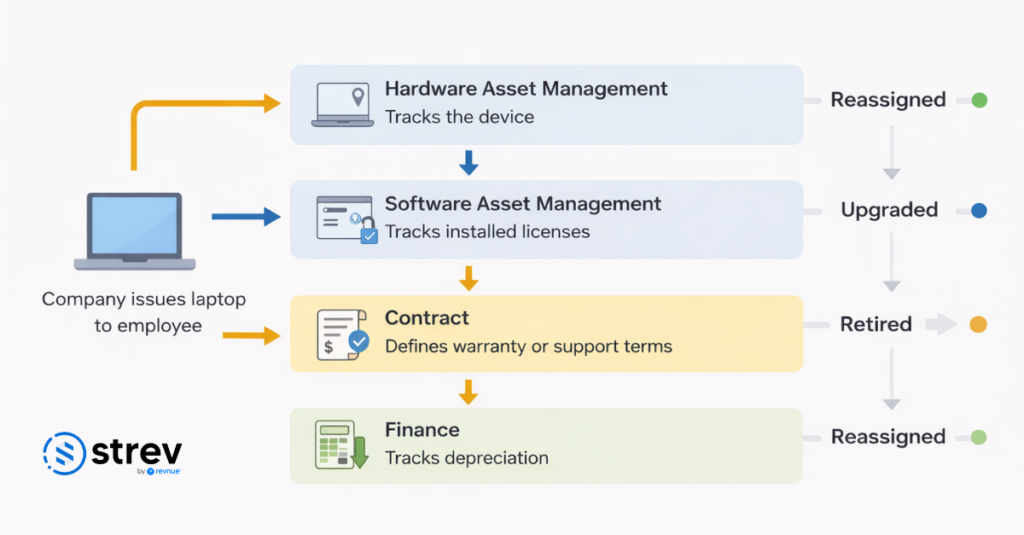
Each step involves a different type of asset management, but the asset itself is the same.
Without coordination, these processes become fragmented. Teams maintain separate records. Updates are missed. Ownership becomes unclear. Decisions rely on incomplete information.
This is why organizations combine multiple types.
However, using multiple systems introduces its own challenge. Data must remain consistent across tools. If hardware records are updated but software or contract records are not, the system breaks down. Over time, teams lose trust in the data and revert to manual tracking.
The goal is not to use more tools. It is to ensure these types work together.
Which Type of IT Asset Management Do You Need?
The answer depends on your current maturity.
Organizations in early stages often focus on hardware tracking to establish visibility. As they grow, they introduce software and cloud management to handle complexity. At scale, lifecycle management becomes necessary to coordinate everything.
There is no single starting point that fits all organizations. However, most eventually move toward lifecycle-based systems as their needs evolve.
How Modern Platforms Bring IT Asset Management Together
Modern platforms aim to eliminate fragmentation by unifying the different types of IT asset management into a single system.
This is where Strev plays a role.
Instead of managing hardware, software, and documentation separately, Strev connects them within a lifecycle-driven framework. Assets are linked to licenses, contracts, approvals, and ownership, allowing teams to manage everything in context.
With mobile access and real-time updates, asset data remains accurate across locations. This reduces manual work and improves coordination between teams.
Final Thoughts
The types of IT asset management exist because modern assets don’t behave the same way. Hardware, software, cloud, financial, and digital assets each require different approaches. The challenge is not managing them individually. It is managing how they work together.
Most organizations build separate systems for each type. Over time, this creates fragmentation. Data becomes inconsistent, workflows break, and teams rely on manual coordination.
The shift is moving from isolated asset types to a lifecycle-driven approach. Instead of focusing on tracking assets, organizations need to manage everything that happens around them: ownership, renewals, documentation, and decisions.
Platforms like Strev Asset Management reflect this shift by connecting asset types into a single system.
Because in the end, effective asset management is not about what you track. It’s about what you can act on.