
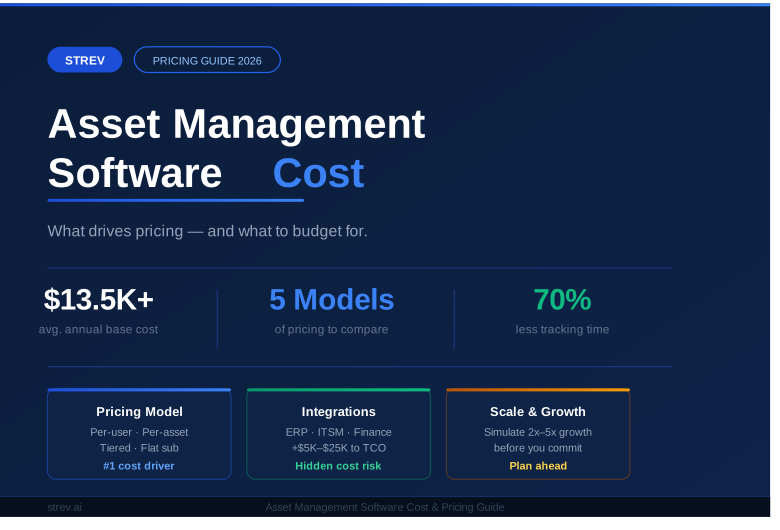
Asset management software cost varies from free open-source tools to $150+ per user per month for enterprise platforms — and understanding what drives that spread is the key to making a smart buying decision.
If you’ve started researching asset management software, you’ve already noticed something: pricing is all over the place.
Some platforms advertise entry-level plans for under $50/month. Others require a custom enterprise quote that can run into tens of thousands of dollars annually. And then there’s everything in between.
So what actually drives asset management software cost — and what should your organization realistically budget for?
This guide breaks it all down: the most common pricing models, real benchmark cost ranges by business size and industry, hidden fees to watch for, and a practical framework for evaluating total value. Whether you’re a growing SMB or a global enterprise, by the end of this, you’ll know exactly what to expect.
What Does Asset Management Software Cost?
Asset management software typically costs between $20 and $80 per user per month for small businesses, $80–$150 per user per month for mid-market organizations, and $150+ per user per month (or custom annual contracts starting at $13,500/year) for enterprise deployments. Cost varies based on asset volume, integration requirements, deployment model, and support level.
The wide spread exists because the term “asset management software” covers very different use cases — from basic hardware tracking to full asset lifecycle management spanning IT, facilities, procurement, and finance. According to Gartner, the global IT asset management software market continues to expand as organizations seek unified visibility across increasingly complex technology stacks.
Here is a realistic benchmark breakdown by business tier:
| Plan / Tier | Typical Price Range | Best For | Key Limitations |
| Free / Open Source | $0 (self-hosted) | Very small teams; basic hardware tracking only | No integrations, automation, or lifecycle mgmt |
| SMB (Starter) | $20–$80/user/month | Small businesses tracking up to ~500 assets | Limited reporting; feature-gated advanced tools |
| Mid-Market | $80–$150/user/month | Teams needing integrations, workflows, reporting | May require custom API for non-native integrations |
| Enterprise | $150+/user/month or custom | Multi-site, multi-department, compliance-heavy orgs | Long procurement cycles; custom pricing opacity |
| Annual Contract (Base) | $13,500–$50,000+/year | Larger organizations with negotiated licensing | Watch for auto-renewal clauses and tier lock-in |
Note: Per-asset pricing models (common with platforms like Strev) can be more cost-effective for large teams since you’re not paying per seat. More on this below.
Asset Management Software Pricing Models Explained
Before comparing asset management system prices, you need to understand how different vendors structure their pricing. The model determines not just what you pay today, but how costs will grow as your organization scales.
1. Per-User Pricing
The most common model. You pay a monthly or annual fee for each person who needs access to the platform. This works well for small teams but can become expensive fast — adding 10 more users means 10x the per-seat cost, even if those users only log in occasionally.
Watch out for: Many vendors charge the same per-seat rate for power users and read-only users. Look for role-based tiering.
2. Per-Asset Pricing
You pay based on the number of assets managed — not the number of users. This model is increasingly popular because it aligns cost with the actual scale of your operations and allows unlimited team members to access the system. Platforms using this model (like Strev) are especially cost-efficient for larger organizations.
Watch out for: Pricing thresholds that trigger cost jumps at round numbers (e.g., 500, 1,000, 5,000 assets).
3. Tiered / Feature-Based Pricing
The vendor offers multiple plan tiers (Basic, Professional, Enterprise), with each tier unlocking additional features. The base price looks affordable, but the features you actually need — like integrations, advanced reporting, or audit trails — are often behind higher tiers.
Watch out for: Core features locked behind an “Enterprise” tier requiring a custom quote.
4. Flat Subscription
A fixed monthly or annual fee regardless of users or asset count. Simple to budget for, but rare at the enterprise level. More common in smaller, specialist tools.
5. On-Premise / Perpetual License
A one-time license fee with optional annual maintenance contracts. Lower long-term cost in theory, but requires in-house IT support, server infrastructure, and manual upgrades. Being phased out in favor of cloud SaaS as organizations shift from CapEx to OpEx spending models.
| Factor | Per-User Pricing | Per-Asset Pricing |
| Cost driver | Number of users | Number of assets managed |
| Best for | Small teams, limited assets | Large asset inventories, large teams |
| Scaling behavior | Increases with headcount | Increases with asset count |
| Example | $50/user × 20 users = $1,000/mo | $0.10/asset × 10,000 assets = $1,000/mo |
| Risk | Penalizes adding team access | Cost jumps at asset count thresholds |
IT Asset Management Software Price
IT asset management (ITAM) is a distinct sub-category with its own competitive landscape and pricing dynamics. ITAM platforms focus specifically on tracking software licenses, hardware inventory, and IT asset lifecycle management — and they typically command mid-market to enterprise pricing.
According to NIST guidelines (NISTIR 8011), organizations managing IT assets at scale require systematic discovery, inventory, and control processes — all of which have direct implications for the software capabilities (and price) you need. Similarly, the ISO 55000 international standard for asset management defines best practices that enterprise-grade ITAM platforms are built to support.
Here is how major ITAM platforms compare on pricing:
| Platform | Starting Price | Pricing Model | Best For | Deployment |
| Strev | Transparent; scales by usage | Per-asset / usage-based | Mid-market to Enterprise; unified platform | Cloud (SaaS) |
| Snipe-IT | Free (self-hosted) | Open source / hosted plans | SMB; IT hardware tracking | Cloud or On-Premise |
| Freshservice | ~$19/agent/month | Per-user (tiered) | SMB to Mid-Market; ITSM + ITAM | Cloud (SaaS) |
| ServiceNow ITAM | Custom enterprise pricing | Custom / negotiated | Large enterprise; full ITSM suite | Cloud |
| Lansweeper | ~$219/mo (base) | Per-device / flat | IT asset discovery + tracking | Cloud or On-Premise |
| Asset Panda | Custom pricing | Per-user (tiered) | SMB to Mid-Market; flexible tracking | Cloud (SaaS) |
Note: Pricing data is approximate and based on publicly available information as of 2026. Enterprise pricing is typically negotiated; always request a custom quote.
For organizations managing software licensing specifically, IT asset management capabilities — including license reconciliation, compliance reporting, and integration with procurement workflows — are essential features to evaluate at any price tier.
Asset Tracking Software Cost: Hardware, Software, and Implementation
Asset tracking software cost is not just a software subscription — it often includes hardware components (barcode scanners, RFID readers, QR labels) and implementation work that are easy to underestimate. Platforms with built-in QR and barcode tracking can significantly reduce hardware costs by eliminating the need for dedicated scanning equipment.
Here is a full cost breakdown for organizations deploying asset tracking:
| Cost Component | Low Estimate | High Estimate | Notes |
| Software license | $20/user/month | $150+/user/month | Varies by features and asset volume |
| Barcode labels / QR tags | $0.05/label | $0.50/label | Depends on material and print volume |
| Barcode scanners / hardware | $50/device | $500+/device | Ruggedized scanners cost more |
| RFID infrastructure | $500 | $10,000+ | Reader hardware + tags; higher upfront |
| Implementation / setup | $0 (self-serve) | $25,000+ | Cloud SaaS is often zero to near-zero |
| Annual maintenance | $0 | $5,000+ | On-premise deployments carry higher cost |
Cloud-native SaaS platforms with mobile-first barcode and QR scanning (using smartphone cameras) can reduce hardware costs to near zero for many deployments.
What Drives Asset Management Software Cost?
Two vendors may quote you very different prices for what appears to be the same product. Here are the five factors that most commonly drive that gap.
1. Scope of Asset Coverage
Platforms that manage only IT hardware cost less than those covering software licenses, contracts, physical infrastructure, facilities, and vendor relationships. If you need a unified system across departments — spanning asset management, contract management, and vendor management — expect to pay more, but also expect to eliminate multiple point solutions.
2. Integration Requirements
Asset management software rarely operates in isolation. Most organizations need it to connect with ERP and financial systems, service desks and ITSM platforms, procurement management tools, and identity and access management (IAM) systems.
Some vendors include a library of native integrations. Others charge separately or require custom API development, which can add $5,000–$25,000+ to your total implementation cost.
3. Implementation and Onboarding
Setup costs are frequently underestimated. Depending on the complexity of your environment, you may need data migration from spreadsheets or legacy systems, custom configuration and field mapping, training for multiple departments, and change management support.
Platforms that are quick to deploy (like cloud-native SaaS tools) can reduce this to near zero. On-premise or heavily customizable platforms can carry implementation fees of $10,000–$50,000+ for enterprise deployments.
4. Number of Assets and Scale
Even on user-based pricing models, scale affects cost indirectly. More assets means more data storage, more API calls, more reporting load. Vendors may impose asset limits at lower tiers, pushing larger organizations into higher-priced plans.
5. Support and Service Level
Base subscriptions often include email support and documentation only. Higher-touch support — dedicated account managers, phone support, SLAs, or white-glove onboarding — is typically reserved for enterprise plans or charged as an add-on. Purpose-built reporting and analytics capabilities are another feature frequently gated behind higher service tiers.
Hidden Costs in Asset Management Software Price
This is where organizations consistently underestimate their total spend. Here are the most common hidden costs to probe before signing a contract:
- Feature gating: Audit trails, custom fields, advanced analytics, and compliance reporting often require plan upgrades
- Integration fees: Native integrations may be bundled, but connecting to less common systems may carry additional licensing or development costs
- Data migration: Moving existing asset records into a new platform can take significant time — and cost $5,000–$25,000+ for complex enterprise environments
- Storage overage: Some vendors charge extra once asset data or document storage exceeds plan limits
- Training and onboarding: Vendor-led onboarding sessions, certification programs, and ongoing training may be billed separately
- Contract auto-renewals: Annual contracts that auto-renew without usage review can lock organizations into pricing that no longer fits their scale — making robust contract management a critical capability in its own right
A practical rule: always ask vendors for a “total cost of ownership” breakdown over 3 years, not just the Year 1 subscription price. McKinsey research on enterprise software adoption consistently identifies hidden implementation costs as the leading cause of budget overruns in technology deployments.
Cloud vs. On-Premise Asset Management: Pricing Comparison
The deployment model you choose has a significant impact on both the structure and total amount of your asset management software spend. Most modern organizations choose cloud SaaS for faster deployment, lower maintenance overhead, and easier scalability — shifting from a CapEx model to a predictable OpEx model.
| Factor | Cloud (SaaS) | On-Premise |
| Upfront cost | Low — subscription-based, no infrastructure | High — licensing + servers + IT setup |
| Ongoing cost | Predictable monthly/annual fee | Lower long-term if properly maintained |
| Deployment time | Days to weeks | Weeks to months |
| Maintenance burden | Vendor-managed updates | Internal IT team required |
| Scalability | Immediate, elastic | Requires hardware investment |
| Compliance control | Shared responsibility model | Full in-house control |
| Typical pricing | $20–$150+/user/month | $15,000–$100,000+ upfront + annual maintenance |
As Forrester Research has documented, organizations that move asset management to cloud SaaS platforms typically recoup upfront subscription costs within 12–18 months through reduced IT maintenance overhead and faster deployment cycles.
Asset Management Software Pricing by Business Size and Industry
Asset management needs — and therefore pricing — vary significantly by industry vertical. A healthcare organization tracking medical devices under FDA compliance requirements has fundamentally different platform needs than a technology company managing software licenses.
| Industry | Typical Tier | Common Use Cases | Key Pricing Considerations |
| IT / Technology | Mid-Market to Enterprise | Software license tracking, ITAM compliance | ITAM compliance requirements drive cost up |
| Healthcare | Enterprise | Medical device lifecycle, regulatory compliance | HIPAA requirements; audit trail features essential |
| Government / Public Sector | Custom / ERP-integrated | Fixed assets, compliance reporting | Procurement rules; often requires on-premise options |
| Retail / Restaurant | SMB to Mid-Market | Equipment, fixtures, POS hardware | Fixed asset depreciation tracking; multi-site |
| Manufacturing | Mid-Market to Enterprise | Physical asset lifecycle, IoT, predictive maintenance | High asset volume; per-asset pricing often best |
| Higher Education | Mid-Market | IT assets, facilities, lab equipment | Multi-department access; role-based user tiers |
For government and public sector organizations, procurement regulations often require specific compliance certifications and audit capabilities that push costs into the enterprise tier. Resources like the NIST Cybersecurity Framework and ISO 55000 provide the compliance standards that drive enterprise-grade asset management requirements.
How to Evaluate Asset Management Software Price Effectively
The right way to evaluate asset management software price isn’t to find the lowest number — it’s to understand the total value delivered over time relative to total spend.
Here’s a practical 4-part evaluation framework:
Step 1: Anchor on Total Cost of Ownership (TCO)
Add up: subscription fee + implementation + integrations + training + ongoing support over 36 months. A $30/user/month tool with $20,000 in implementation costs may be more expensive overall than a $75/user/month platform that deploys in days. IBM’s enterprise TCO methodology recommends this same 36-month window as the standard evaluation horizon for SaaS investments.
Step 2: Model How Pricing Scales With You
Simulate your cost at 2x and 5x your current size. Does the pricing model penalize growth? Per-asset pricing tends to scale more predictably than per-user models for organizations adding headcount faster than asset count. Platforms with built-in workflow automation and operations management capabilities also reduce the manual overhead cost that typically grows with organizational scale.
Step 3: Assess Operational Impact
If a platform saves your team 10 hours per week in manual tracking and reconciliation, that has a real dollar value. Factor in time saved, errors reduced, and audits simplified when comparing options. AI-powered capabilities like AI metadata extraction can further accelerate ROI by automating data entry and asset categorization that would otherwise require manual effort.
Step 4: Evaluate Ecosystem Fit
Poor integration with your existing tech stack creates fragmented data and duplicate effort — both of which are invisible costs. Evaluate the depth of native integrations available before committing. A platform with 50+ native integrations eliminates the $5,000–$25,000+ custom API development cost that less-integrated tools require.
Key Questions to Ask Asset Management Software Vendors
When evaluating platforms, use these questions to cut through the pricing noise:
- What is included in the base subscription — and what requires an upgrade?
- Are integrations with [your specific tools] native or custom?
- What are the asset and user limits at each pricing tier?
- Is onboarding and data migration included or billed separately?
- What support level is included, and what does premium support cost?
- How has your pricing changed over the past two years?
- What does pricing look like at 2x our current asset count?
- Do you offer annual vs. monthly billing discounts?
- What compliance certifications does the platform hold (SOC 2, ISO 27001, etc.)?
- How does pricing change if we add departments or geographic regions?
How Strev Approaches Asset Management Software Pricing
Strev’s asset management system is designed to deliver transparent, scalable pricing without the common pitfalls of legacy ITAM platforms. Rather than locking core capabilities behind enterprise tiers, Strev gives organizations real-time visibility across assets, contracts, vendors, and ITOps from day one — with pricing that scales based on what you actually use, not arbitrary seat limits.
For organizations looking to reduce total cost of ownership, Strev’s unified platform replaces the need for multiple point solutions — eliminating the hidden cost of managing fragmented toolsets across asset lifecycle management, contract management, and vendor management. Over 200 organizations have reduced their asset tracking time by up to 70% using Strev, with measurable ROI from day one.
Start free, pay only for what you use. No hidden fees.
Frequently Asked Questions: Asset Management Software Cost & Pricing
How much does asset management software cost on average?
Asset management software price typically ranges from $20–$80/user/month for SMB tools to $150+ per user per month (or custom enterprise contracts) for larger organizations. Annual contract pricing for enterprise platforms often starts around $13,500/year and scales based on asset count, users, and features required.
How much does IT asset management software cost?
IT asset management (ITAM) software typically starts at $19–$50/user/month for SMB-focused platforms like Freshservice, with enterprise platforms like ServiceNow ITAM requiring custom pricing that can run $50,000–$200,000+/year for large deployments. Per-device or per-asset pricing models are increasingly common and often more cost-effective for organizations with large IT asset inventories.
How do I calculate the ROI of asset management software?
ROI calculation should factor in: hours saved per week in manual tracking × average hourly labor cost × 52 weeks, plus reduction in asset loss/theft, improved software license compliance (avoiding over-purchasing or audit penalties), and faster audit preparation. A platform that saves 10 hours per week for a $50/hour team member generates $26,000/year in labor savings alone — which often exceeds the annual subscription cost.
What is the difference between asset management software price and total cost?
The listed price (subscription fee) is only part of what you’ll pay. Total cost includes implementation and data migration, integration development, training, premium support tiers, and potential feature upgrades. Always evaluate total 3-year cost of ownership, not just the monthly subscription.
Is free asset management software worth it?
Free or open-source tools (like Snipe-IT) can work for very small teams with basic hardware tracking needs. However, they typically lack integrations, automation, lifecycle management, and compliance features. For growing businesses, the time cost of managing limitations often outweighs the savings on licensing.
What pricing model is best for large enterprises?
Per-asset pricing tends to be more cost-effective for large enterprises since it doesn’t penalize you for adding team members who need access. User-based pricing can become prohibitively expensive as organizations scale headcount. Always model 3-year costs under each pricing structure.
Are there hidden fees in asset management software?
Yes, commonly. Watch for feature gating (core functionality locked behind higher tiers), integration fees, data migration costs, storage overages, and training charges. Always request a full 36-month total cost of ownership breakdown before signing a contract.
How does asset management software pricing compare between cloud and on-premise?
Cloud (SaaS) platforms have lower upfront costs — typically subscription-based with no infrastructure investment — but recurring fees add up over time. On-premise deployments have higher upfront costs (licensing + infrastructure + IT resources) but can be cheaper long-term. Most modern organizations choose SaaS for faster deployment, lower maintenance overhead, and easier scalability.
What is included in asset management software pricing?
Base pricing typically includes core asset tracking, a standard number of users or assets, and basic support. Higher tiers add: advanced reporting and analytics, workflow automation, compliance and audit trails, native integrations, dedicated support, and data migration assistance. Always request a feature matrix alongside pricing to understand exactly what each tier includes.
The Bottom Line
Asset management software cost is not a single number — it’s a function of your organization’s size, complexity, required integrations, and long-term growth trajectory.
The platforms that look cheapest at first glance are often not the most cost-efficient when you factor in hidden fees, scaling penalties, and the operational drag of under-featured tools. The most expensive-looking platforms are sometimes the best value when you account for what they replace and the time they save.
The right approach: model your total cost of ownership over 3 years, simulate what pricing looks like as you scale, and evaluate each platform on the value it delivers — not just the subscription line item.
Ready to see what Strev costs for your organization? Start free with no hidden fees, and experience transparent pricing built for teams of all sizes.